PMMA / CNC manufacturing / traceability
PMMA materials and processes
The technical value of a PMMA component comes from controlling the full chain: formulation, monomer conversion, thickness management, mechanical machining, finishing and final inspection.
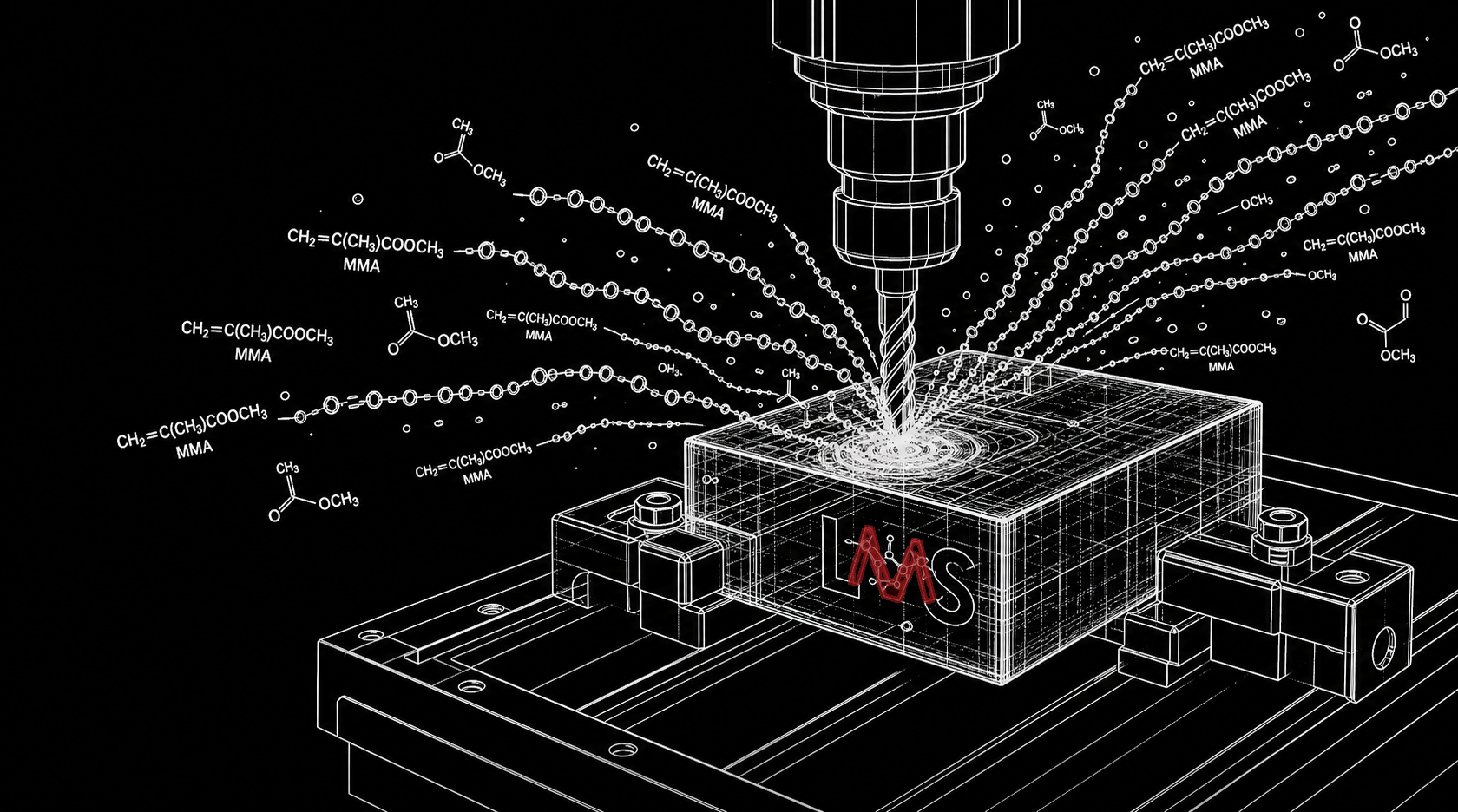
From monomer to finished component
LMS connects polymer research, semi-finished material production, mechanical machining, manual finishing and final inspection. This reduces external passages and keeps technical responsibility over the whole component.
Formulation and modification
Copolymers, microfillers, nanofillers, colours and special functions must be compatible with transparency, viscosity, dispersion, polymerization and machinability.
Machining process
PMMA requires specific parameters: heat control, chip evacuation, proper tooling, roughing and finishing sequences, subsequent polishing and microscopic verification.
Polishing and finishing
Machine and hand polishing, craft finishing, control of internal and external surfaces, with attention to edges, deep holes, radii and optical areas of the component.
Technical delivery
The finished item is not just a machined part: it is a component with material history, production route, inspection records and customer-accessible traceability.